Het Italiaanse familiegevoel ge-etaleerd in D&G advertenties blijkt toch niet de juiste toon om de Chinese consument te bereiken. Carl Rohde schrijft in het FD van 29/8/15 over de Chinese beoordeling van de D&G familiefoto's gebruikt voor de advertentiecampagne. Waar in Italie de foto's staan voor de kwaliteit van leven, luxueuze expressiviteit en tradities, zien de Chinezen andere dingen op de foto's. Hun commentaar: "Oma ontbreekt, dit is geen familie, vader en moeder staan niet samen in het midden, geen harmonie, te vol".
Menige marketingcampagne die over de grenzen reikt, blijkt minder effectief dan vooraf bedacht. Kennis over de culturele achtergrond en input van de mens ter plekke levert op!
Carl Rohde in het FD
vrijdag 4 september 2015

zondag 25 mei 2014
Human Resources in China
Human Resources Management in China by J. Bruynzeel
Part of a paper written for the course Contemporary China, MA Asian Studies at Leiden University, April 2014
Human resources management is subject to change through time and place. During the Mao-era, the Chinese state issued rules and regulations for cadres and workers in the state owned companies. After 1978 the state–driven economy changed into a market-driven one that demanded different styles of human resources management. Foreign companies entered China and, through international joint ventures, the Chinese employees were subject to different styles of human resources management.
China HRM practices vary through time. Starting with specific Chinese HRM practices in the pre-reform and early reform years, HRM is described as hybrid with strong Confucian values in the next phase, moving to ‘beyond hybrid’ in recent years, and ending with the current beginning of changes caused by the new generation of only-children that will hold management positions in enterprises in China. Both Nankervis (2013: p. 191) and Dirlik (2001: p. 12) mentioned the current and coming changes caused by this new generation. Dirlik described this generation as having values different from their parents, including self-centeredness, different from the currently known Chinese family values and interpersonal relationships.
In my view HR practices in the world are moving towards each other, and are foremost a pragmatic solution for occurring situations, and less a deliberate strategy of transnational enterprises in capitalist markets, as in the description of cultural imperialism by Dirlik. A dominant HR approach is to be seen, not influenced by one specific country culture, but arising from the capitalist market demands. The region in the world having the strongest demand will, in my view, strongly influence the HR practices in other parts of the world.
The various authors I quote in this paper, all have a view, a recommendation or an opinion about the route Chinese HRM is going, and whether elements of Western and/or Asian HR practices will be included resulting in a HRM hybrid. I will give an overview of the authors’ opinions and their argumentation in a chronological order.
Zhu & Dowling (1998: pp. 131-133) referred to research and surveys done in the 1990’s when asking the question whether a Western-style appraisal form that encourages individual economic performance, could be directly introduced to China. Their answer to this question was that it could only be done with a Chinese perspective and when incorporating Chinese methods like harmonious functioning in a work group, and fulfilment of individual obligation towards the work unit and colleagues. Their view for future PA development was that it will move away from egalitarian distribution and will become more objective making use of measurable methodology. It would in their view continue to be utilized in China’s enterprises as a useful tool to help raise work effort by linking compensation more closely to tasks and responsibilities.
Cunningham (2010: pp. 2136-2137) focused solely on Western HRM systems and concluded that the process towards Western HRM methods in SMEs is a slow one. He did acknowledge a specific Chinese mindset he referred to as the Confucian value-system that may hinder the movement towards ‘purely’ Westernized HRM practices. At the same time he acknowledged the fact that the best HRM system is the one that fits best in the local situation of the SME, taking into account cultural, national and enterprise differences.
Warner (2010: pp. 2073) questioned whether a Chinese model of HRM, with Chinese characteristics, will be a Confucian-based HRM variety. He saw a marriage of Confucian inheritance with Sino-Marxist forces, moving towards a pragmatic Confucian ‘soft power’ in the workplace.
Su & Wright (2012: pp. 2083) named the evolving HRM system a hybrid one that combines control-based HR practices from China with commitment-based ones from the West. They concluded that the effectiveness of a HRM system needs to be seen in a certain management context.
Zheng (2013: pp. 249-250) surveyed four Chinese-Japanese JV’s and found that the HR practices applied in the branches were the result of an ongoing process of evaluation, testing and modifying of the existing HR practices, and adapting them to the specific circumstances of a branch, including the internal and external contexts. This process was fed with HR practices from the parent company, local Chinese practices and Western HR influences. Zheng claimed the outcome to be far beyond a hybrid version of HRM. When looked at the PA system applied in the four JV’s, three of them are making use of the Management by Objectives (MBO) PA, also when the parent company still makes use of a seniority-based appraisal. One JV did use the MBO for appraisal but it was a top-down process and completely in the hands of the general manager (similar to the Japanese parent company).
Nankervis (2013: p. 191) refers to research by Cooke in 2010 showing that China’s younger generation of professionals and management appear less risk-aversive and more receptive to Western motivators like individual recognition, career advancement, performance-related pay. They seem to be moving away from the traditional Confucian culture of the older generations.
Sources
Business Dictionary 2014, Human Resource Management. Available from: http://www.businessdictionary.com/definition/human-resource-management-HRM.html. [22 April 2014].
Cunningham, LX 2010, ‘Managing Human Resources in SMEs in a transition economy: evidence from China’, The International Journal of Human Resource Management, vol. 21, no. 12, pp. 2120-2141.
Dirlik, A 2001, ‘Markets, Culture, Power: The Making of a “Second Cultural Revolution” in China’, Asian Studies Review, vol. 25, no. 1, pp. 1-33.
Lin, Z, Trenberth, L & Kelly, J 2010, ‘The development and implications of China’s employee benefit system’, Asia Pacific Journal of Human Resources, vol. 48, no. 3, pp. 287-301.
McEllister, R 1998, ‘Recruitment and retention of managerial staff’ in International Management in China, Cross-cultural issues, ed J Selmer, Routledge, New York, pp. 98-114.
Nankervis, AR 2013, ‘Building for the future? Government and industry responses to the challenges of talent management in China following the GFC.’, Asia Pacific Business Review, vol. 19, no. 2, pp. 186-199.
Su, ZX & Wright, PM 2012, ‘The effective human resource management system in transitional China: a hybrid of commitment and control practices’, The International Journal of Human Resource Management, vol. 23, no. 10, pp. 2065-2068.
Tomlinson, J 2012, ‘Cultural Imperialism’ in The Wiley-Blackwell Encyclopedia of Globalization, ed G Ritzen, John Wiley and Sons, New York, abstract. Available from: http://onlinelibrary.wiley.com/doi/10.1002/9780470670590.wbeog129/abstract [6 April 2014]
Warner, M 2010, ‘In search of Confucian HRM: theory and practice in Greater China and beyond’, The International Journal of Human Resource Management, vol. 21, no. 12, pp. 2053-2078
Warner, M 2011, ‘Society and HRM in China’, The International Journal of Human Resource Management, vol. 22, no. 16, pp. 3223-3244.
Wikipedia, The Free Encyclopedia 2014, Human Resource Management. Available from:. [6 April 2014].
Zheng, Y 2013, Managing Human Resources in China, The View from Inside Multinationals, Cambridge University Press, New York.
Zhu, CJ & Dowling, P 1998, ‘Performance appraisal in China’ in International Management in China, Cross-cultural issues, ed J Selmer, Routledge, New York, pp. 115-136.
Part of a paper written for the course Contemporary China, MA Asian Studies at Leiden University, April 2014
Human resources management is subject to change through time and place. During the Mao-era, the Chinese state issued rules and regulations for cadres and workers in the state owned companies. After 1978 the state–driven economy changed into a market-driven one that demanded different styles of human resources management. Foreign companies entered China and, through international joint ventures, the Chinese employees were subject to different styles of human resources management.
China HRM practices vary through time. Starting with specific Chinese HRM practices in the pre-reform and early reform years, HRM is described as hybrid with strong Confucian values in the next phase, moving to ‘beyond hybrid’ in recent years, and ending with the current beginning of changes caused by the new generation of only-children that will hold management positions in enterprises in China. Both Nankervis (2013: p. 191) and Dirlik (2001: p. 12) mentioned the current and coming changes caused by this new generation. Dirlik described this generation as having values different from their parents, including self-centeredness, different from the currently known Chinese family values and interpersonal relationships.
In my view HR practices in the world are moving towards each other, and are foremost a pragmatic solution for occurring situations, and less a deliberate strategy of transnational enterprises in capitalist markets, as in the description of cultural imperialism by Dirlik. A dominant HR approach is to be seen, not influenced by one specific country culture, but arising from the capitalist market demands. The region in the world having the strongest demand will, in my view, strongly influence the HR practices in other parts of the world.
The various authors I quote in this paper, all have a view, a recommendation or an opinion about the route Chinese HRM is going, and whether elements of Western and/or Asian HR practices will be included resulting in a HRM hybrid. I will give an overview of the authors’ opinions and their argumentation in a chronological order.
Zhu & Dowling (1998: pp. 131-133) referred to research and surveys done in the 1990’s when asking the question whether a Western-style appraisal form that encourages individual economic performance, could be directly introduced to China. Their answer to this question was that it could only be done with a Chinese perspective and when incorporating Chinese methods like harmonious functioning in a work group, and fulfilment of individual obligation towards the work unit and colleagues. Their view for future PA development was that it will move away from egalitarian distribution and will become more objective making use of measurable methodology. It would in their view continue to be utilized in China’s enterprises as a useful tool to help raise work effort by linking compensation more closely to tasks and responsibilities.
Cunningham (2010: pp. 2136-2137) focused solely on Western HRM systems and concluded that the process towards Western HRM methods in SMEs is a slow one. He did acknowledge a specific Chinese mindset he referred to as the Confucian value-system that may hinder the movement towards ‘purely’ Westernized HRM practices. At the same time he acknowledged the fact that the best HRM system is the one that fits best in the local situation of the SME, taking into account cultural, national and enterprise differences.
Warner (2010: pp. 2073) questioned whether a Chinese model of HRM, with Chinese characteristics, will be a Confucian-based HRM variety. He saw a marriage of Confucian inheritance with Sino-Marxist forces, moving towards a pragmatic Confucian ‘soft power’ in the workplace.
Su & Wright (2012: pp. 2083) named the evolving HRM system a hybrid one that combines control-based HR practices from China with commitment-based ones from the West. They concluded that the effectiveness of a HRM system needs to be seen in a certain management context.
Zheng (2013: pp. 249-250) surveyed four Chinese-Japanese JV’s and found that the HR practices applied in the branches were the result of an ongoing process of evaluation, testing and modifying of the existing HR practices, and adapting them to the specific circumstances of a branch, including the internal and external contexts. This process was fed with HR practices from the parent company, local Chinese practices and Western HR influences. Zheng claimed the outcome to be far beyond a hybrid version of HRM. When looked at the PA system applied in the four JV’s, three of them are making use of the Management by Objectives (MBO) PA, also when the parent company still makes use of a seniority-based appraisal. One JV did use the MBO for appraisal but it was a top-down process and completely in the hands of the general manager (similar to the Japanese parent company).
Nankervis (2013: p. 191) refers to research by Cooke in 2010 showing that China’s younger generation of professionals and management appear less risk-aversive and more receptive to Western motivators like individual recognition, career advancement, performance-related pay. They seem to be moving away from the traditional Confucian culture of the older generations.
Sources
Business Dictionary 2014, Human Resource Management. Available from: http://www.businessdictionary.com/definition/human-resource-management-HRM.html. [22 April 2014].
Cunningham, LX 2010, ‘Managing Human Resources in SMEs in a transition economy: evidence from China’, The International Journal of Human Resource Management, vol. 21, no. 12, pp. 2120-2141.
Dirlik, A 2001, ‘Markets, Culture, Power: The Making of a “Second Cultural Revolution” in China’, Asian Studies Review, vol. 25, no. 1, pp. 1-33.
Lin, Z, Trenberth, L & Kelly, J 2010, ‘The development and implications of China’s employee benefit system’, Asia Pacific Journal of Human Resources, vol. 48, no. 3, pp. 287-301.
McEllister, R 1998, ‘Recruitment and retention of managerial staff’ in International Management in China, Cross-cultural issues, ed J Selmer, Routledge, New York, pp. 98-114.
Nankervis, AR 2013, ‘Building for the future? Government and industry responses to the challenges of talent management in China following the GFC.’, Asia Pacific Business Review, vol. 19, no. 2, pp. 186-199.
Su, ZX & Wright, PM 2012, ‘The effective human resource management system in transitional China: a hybrid of commitment and control practices’, The International Journal of Human Resource Management, vol. 23, no. 10, pp. 2065-2068.
Tomlinson, J 2012, ‘Cultural Imperialism’ in The Wiley-Blackwell Encyclopedia of Globalization, ed G Ritzen, John Wiley and Sons, New York, abstract. Available from: http://onlinelibrary.wiley.com/doi/10.1002/9780470670590.wbeog129/abstract [6 April 2014]
Warner, M 2010, ‘In search of Confucian HRM: theory and practice in Greater China and beyond’, The International Journal of Human Resource Management, vol. 21, no. 12, pp. 2053-2078
Warner, M 2011, ‘Society and HRM in China’, The International Journal of Human Resource Management, vol. 22, no. 16, pp. 3223-3244.
Wikipedia, The Free Encyclopedia 2014, Human Resource Management. Available from:
Zheng, Y 2013, Managing Human Resources in China, The View from Inside Multinationals, Cambridge University Press, New York.
Zhu, CJ & Dowling, P 1998, ‘Performance appraisal in China’ in International Management in China, Cross-cultural issues, ed J Selmer, Routledge, New York, pp. 115-136.
woensdag 3 april 2013
China aan de koffie? Nestlé investeert in Yunnan.
Naar aanleiding van het bericht dat het Zwitserse Nestlé groot gaat investeren in de Chinese provincie Yunnan met o.a. een koffietrainingscentrum voor 5000 boeren en een koffie-experience centrum voor toeristen, vroeg radio BNR mij om toelichting en achtergronden.
De koffiemarkt in China is interessant voor de koffiemultinationals vanwege de enorme potentie die zij daar zien: de Chinees drinkt gemiddeld 4 kopjes koffie per jaar tegenover de Fransman met 600. Dat doen de Chinezen op dit moment vooral buiten de deur in koffierestaurants, en dat dan vooral in de grote steden. Starbucks is met 800 vestigingen in China het meest bekend.
De ontwikkeling van de koffieconsumptie van buiten de deur naar binnen, met elke Chinees in het bezit van een Nespresso-apparaat, is volgens mij nog niet zo gemakkelijk. Chinezen drinken koffie om te laten zien dat zij de Westerse levensstijl aanhangen en kunnen betalen, als statussymbool. De koffierestaurants hebben zich ontwikkeld tot een huiskamerachtige plek waar iedereen, voor hoe lang zij dat willen, zit te werken, afspraken heeft en studeert. Dat theehuizen van oudsher alleen door mannen werden bezocht, heeft hier in hoge mate aan meegeholpen. De toegankelijkheid van de koffierestaurants heeft vrouwen, families, jonge mensen een plek gegeven.
De provincie Yunnan in Zuid-China, grenzend aan Myanmar, Laos en Vietnam, is heel bekend vanwege de Pu'Er thee, die vanuit Pu'Er via de 1000 jaar oude Zuidelijke Zijderoute naar o.a. Tibet en India werd getransporteerd. En dit is de stad waar Nestlé zijn koffie-investeringen doet. En waar Starbucks aanwezig is met koffiebouw en ontwikkeling. De Yunnan-overheid ondersteunt en stimuleert de koffiemarkt en vooral de ontwikkeling van de kwalitatief betere Arabica koffie. Zij heeft samenwerkingsverbanden met zowel Nestlé als Starbucks.
De koffiebranders hebben zeker een enorme potentiële markt in China voor hun thuiskoffie, echter voor het zover is:
Heb geduld, met behulp van tijd, verandert gras in melk.
Geluidsfragment BNR Radio 4 april 2013
De koffiemarkt in China is interessant voor de koffiemultinationals vanwege de enorme potentie die zij daar zien: de Chinees drinkt gemiddeld 4 kopjes koffie per jaar tegenover de Fransman met 600. Dat doen de Chinezen op dit moment vooral buiten de deur in koffierestaurants, en dat dan vooral in de grote steden. Starbucks is met 800 vestigingen in China het meest bekend.
De ontwikkeling van de koffieconsumptie van buiten de deur naar binnen, met elke Chinees in het bezit van een Nespresso-apparaat, is volgens mij nog niet zo gemakkelijk. Chinezen drinken koffie om te laten zien dat zij de Westerse levensstijl aanhangen en kunnen betalen, als statussymbool. De koffierestaurants hebben zich ontwikkeld tot een huiskamerachtige plek waar iedereen, voor hoe lang zij dat willen, zit te werken, afspraken heeft en studeert. Dat theehuizen van oudsher alleen door mannen werden bezocht, heeft hier in hoge mate aan meegeholpen. De toegankelijkheid van de koffierestaurants heeft vrouwen, families, jonge mensen een plek gegeven.
De provincie Yunnan in Zuid-China, grenzend aan Myanmar, Laos en Vietnam, is heel bekend vanwege de Pu'Er thee, die vanuit Pu'Er via de 1000 jaar oude Zuidelijke Zijderoute naar o.a. Tibet en India werd getransporteerd. En dit is de stad waar Nestlé zijn koffie-investeringen doet. En waar Starbucks aanwezig is met koffiebouw en ontwikkeling. De Yunnan-overheid ondersteunt en stimuleert de koffiemarkt en vooral de ontwikkeling van de kwalitatief betere Arabica koffie. Zij heeft samenwerkingsverbanden met zowel Nestlé als Starbucks.
De koffiebranders hebben zeker een enorme potentiële markt in China voor hun thuiskoffie, echter voor het zover is:
Heb geduld, met behulp van tijd, verandert gras in melk.
Geluidsfragment BNR Radio 4 april 2013
woensdag 6 maart 2013
Officiele benoeming nieuwe Chinese leiders tijdens Volkscongres
Het Chinese Nationale Volkscongres is op dit moment bijeen om de benoeming van de nieuwe Chinese leiders offcieel te maken. De nieuwe leiders zijn tijdens het Volkscongres van november 2012 al bepaald: Xi Jinping volgt president Hu Jintao op, Li Keqiang volgt premier Wen Jiabao op. Wat dat op gaat leveren aan nieuw beleid is voor iedereen afwachten.
Meer van mij over dit onderwerp te beluisteren op Radio 1, om 02:28 uur
Meer van mij over dit onderwerp te beluisteren op Radio 1, om 02:28 uur
dinsdag 15 januari 2013
Traditioneel Chinees wereldbeeld en DWDD
De wereld volgens de oude Chinezen was een afspiegeling (microkosmos) van het grotere geheel (macrokosmos). En alles in de wereld, inclusief de mens, was/is dat ook. Denk aan acupunctuur en voetreflexologie waarbij de drukpunten op het oor respectievelijk de voet, de organen van het lichaam vertegenwoordigen.
In de uitzending van DWDD van dinsdag 15/01/13 is Willem Haverkort, plasmafysicus te gast. Hem wordt gevraagd het verhaal over zijn wetenschappelijk onderzoek af te sluiten met een tweet in het kader van zijn werk: "We kunnen de wereld draaiende houden door het proces van de zon en de sterren hier op aarde na te bootsen."
Deze twee zaken zijn naar mijn idee met elkaar verbonden. Het zoeken naar micro- en macrokosmos op internet levert veel op over de oude Grieken die deze begrippen gebruikten, en niet of nauwelijks over de oude Chinezen. Wie zou als eerste het idee geopperd hebben? De Chinezen of de Grieken?
DWDD fragment
In de uitzending van DWDD van dinsdag 15/01/13 is Willem Haverkort, plasmafysicus te gast. Hem wordt gevraagd het verhaal over zijn wetenschappelijk onderzoek af te sluiten met een tweet in het kader van zijn werk: "We kunnen de wereld draaiende houden door het proces van de zon en de sterren hier op aarde na te bootsen."
Deze twee zaken zijn naar mijn idee met elkaar verbonden. Het zoeken naar micro- en macrokosmos op internet levert veel op over de oude Grieken die deze begrippen gebruikten, en niet of nauwelijks over de oude Chinezen. Wie zou als eerste het idee geopperd hebben? De Chinezen of de Grieken?
DWDD fragment
vrijdag 9 maart 2012
Eerst karaoke, dan pas zaken - NRC Next 9 maart '12:
Met steeds meer Chinese bedrijven die zich vestigen in Nederland wordt het normaler om voor een Chinese baas te werken. Is dat anders dan werken voor een Nederlandse baas in een Nederlands bedrijf? Jazeker.


zondag 4 maart 2012
Hongkong Update
Een recent bezoek aan Hongkong en wat zie je dan:

rijen voor de Hermes en Gucci winkels;

zeven stellen die zich gezamenlijk laten fotograferen in bruidskleding (of 1 stel met 6 bruidsmeisjes);
een stukje Parijs in HK Heritage 1881, opgetuigd met gouden koetsen en fonteinen. Een zitplaats voor een kop koffie in de grote shopping IFC mall was op woensdagmiddag om half 4 onmogelijk: geen plek te vinden, alles vol. En vechten voor een tafeltje in het Mandarin Oriental voor een kopje thee. Of shoppen bij Lane Crawford, waar de luxe schoenen begerig worden bekeken en gekocht door vooral vasteland Chinese vrouwen en een heel klein hoekje is ingericht met schoenen van (slechts) rond de 100 Euro.
Dus ja, zeker booming business. Mijn zakenpartner in HK, Chingmay Jo ontvangt een stijgend aantal tolkopdrachten, uit alle delen van de wereld.
 Hongkong is inmiddels ook een hotspot geworden voor kunst. Vasteland-Chinezen komen naar HK om kunst te kopen. De bezoekers aantallen aan de Hongkong Art Fair worden ieder jaar hoger, en de stad ontwikkelt zich als kunst-hub van Azie.
In Hongkong (7,1 miljoen inwoners) wordt de bevolking ouder, rijker en blijft men langer single. In de South China Morning Post van 22 februari '12, een artikel over demografische ontwikkelingen in HK.
- De gemiddelde leeftijd rees van gemiddeld 36,7 jaar in 2001 naar 41,7 jaar in 2011.
- Het gemiddelde maandinkomen rees van HK$18,710 (ca. 1871 Euro) in 2001 naar HK$20,500 in 2011, een groei van 9,6%. Echter het inflatiepercentage overtroefde dat: 12,5%.
- 23% van de huishoudens had een maandelijks inkomen van HK$40,000 of meer. En dat was in 2001 18%.
- Voor elke 1000 vrouwen zijn er 876 mannen.
- Het aantal single-huishoudens ging van 320.000 in 2001 naar 400.000 in 2011.
- 46,8% van de mannen en 38,9% van de vrouwen tussen de 20 - 49 jaar, is nooit getrouwd geweest.
- De prijs voor woonappartementen ging in 10 jaar met 41% omhoog. De gemiddelde huur per maand is HK$7,500.
Gegevens zijn afkomstig van het Census and Statistics Department in HK.
En om een idee te krijgen hoe Hongkongnezen wonen, een filmpje over een klein 30 m2 appartement in Hongkong voorzien van alle comfort: http://www.youtube.com/watch?v=Lg9qnWg9kak
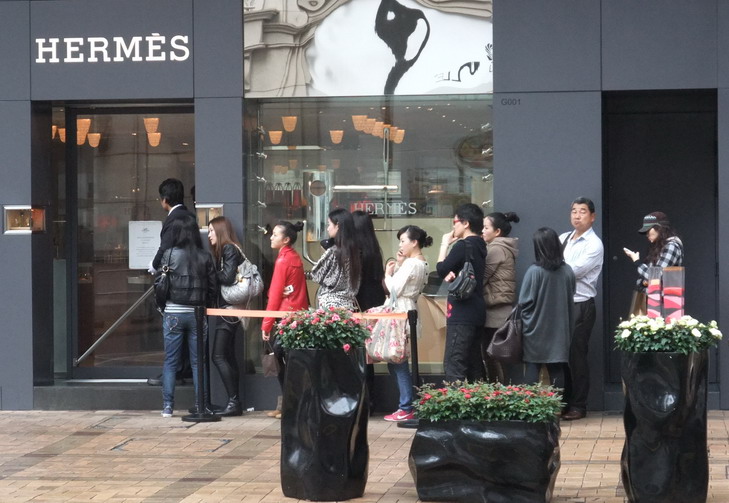
rijen voor de Hermes en Gucci winkels;

zeven stellen die zich gezamenlijk laten fotograferen in bruidskleding (of 1 stel met 6 bruidsmeisjes);

een stukje Parijs in HK Heritage 1881, opgetuigd met gouden koetsen en fonteinen. Een zitplaats voor een kop koffie in de grote shopping IFC mall was op woensdagmiddag om half 4 onmogelijk: geen plek te vinden, alles vol. En vechten voor een tafeltje in het Mandarin Oriental voor een kopje thee. Of shoppen bij Lane Crawford, waar de luxe schoenen begerig worden bekeken en gekocht door vooral vasteland Chinese vrouwen en een heel klein hoekje is ingericht met schoenen van (slechts) rond de 100 Euro.

Dus ja, zeker booming business. Mijn zakenpartner in HK, Chingmay Jo ontvangt een stijgend aantal tolkopdrachten, uit alle delen van de wereld.

In Hongkong (7,1 miljoen inwoners) wordt de bevolking ouder, rijker en blijft men langer single. In de South China Morning Post van 22 februari '12, een artikel over demografische ontwikkelingen in HK.
- De gemiddelde leeftijd rees van gemiddeld 36,7 jaar in 2001 naar 41,7 jaar in 2011.
- Het gemiddelde maandinkomen rees van HK$18,710 (ca. 1871 Euro) in 2001 naar HK$20,500 in 2011, een groei van 9,6%. Echter het inflatiepercentage overtroefde dat: 12,5%.
- 23% van de huishoudens had een maandelijks inkomen van HK$40,000 of meer. En dat was in 2001 18%.
- Voor elke 1000 vrouwen zijn er 876 mannen.
- Het aantal single-huishoudens ging van 320.000 in 2001 naar 400.000 in 2011.
- 46,8% van de mannen en 38,9% van de vrouwen tussen de 20 - 49 jaar, is nooit getrouwd geweest.
- De prijs voor woonappartementen ging in 10 jaar met 41% omhoog. De gemiddelde huur per maand is HK$7,500.
Gegevens zijn afkomstig van het Census and Statistics Department in HK.
En om een idee te krijgen hoe Hongkongnezen wonen, een filmpje over een klein 30 m2 appartement in Hongkong voorzien van alle comfort: http://www.youtube.com/watch?v=Lg9qnWg9kak
Abonneren op:
Posts (Atom)